

Description
Order Status Guide
- Add to cart → Orders placed now will be dispatched on coming Monday-Tuesday.
- Available on Back-order → We are currently filling existing orders. Your order will be allocated to the next available date, and an estimated dispatch timeframe will be emailed once we receive your order. *DO NOT INCLUDE ANY EGGS ON BACK ORDER IF YOU REQUIRE EGGS URGENTLY*
- Out of Stock → Hens are currently not producing enough due to broody hens, or we are monitoring fertility before making eggs available.
- Local pick up orders → We require a minimum of 24–48 hours’ notice to arrange pickup, as eggs need to be brought in from the farm.
- Originated America as a dual purpose birds
- Mature weight is under 2.5 – 4kg
- Moderate maturing – first egg around 7 months
- Large sized light brown coloured eggs,expected to lay between 160-200 per year.
- Broodiness – Moderate – high
- Maintenance – Low
Wyandotte is a popular breed known for its striking appearance, friendly temperament, and excellent egg-laying abilities. Originating in the United States in the 19th century, Wyandottes have become a staple breed for backyard flocks and small farms.
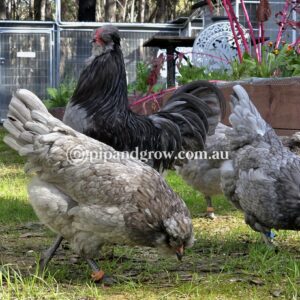
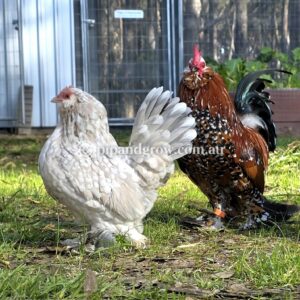
They are medium-sized birds with a broad, rounded body and a distinctive rose comb. They come in a variety of color patterns, including silver-laced, golden-laced, blue, black, white, buff, and more. Each color variety has its own unique beauty, but all Wyandottes share certain traits such as a sturdy build and a calm, docile disposition.
One of the key attributes of Wyandotte is their egg-laying capabilities as well as broody behavior, although individual tendencies can vary. Additionally, they are known to be good foragers and adapt well to a variety of climates, making them suitable for a wide range of environments. They tolerate cold climate well but can overheat during hot season due to their thick plumage, shaded, sheltered area is recommended.
Our line consists of the stunning Red variety in Blue, and Splash Laced Red. Our current breeders have been carefully selected from an exhibitor’s line in NSW and our existing stock. These birds are well sized, with strong frames and excellent lacing quality, making them a standout addition to any flock.
Please see Wyandotte – Open Poultry Standard Australia for more info and breed standards.
Wyandotte Genetic Note : added 27/08/2026
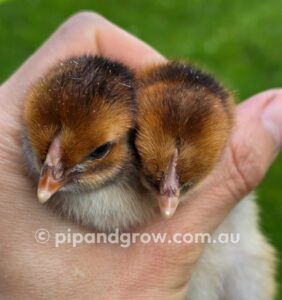 In our recent batch from the 27th of August, we noticed (1/19chicks) hatched with a single comb. As those familiar with poultry genetics will know, a single comb is a recessive trait. This simply means both the rooster and the hen in our current pen happen to carry one copy of this hidden gene.
To share a bit of background, red based colour Wyandottes in Australia were originally developed using Barnevelders to introduce the red colour. Barnevelders share a very similar appearance but feature a single comb with double lacing. Furthermore, roosters that carry only the pure rose comb gene are known for fertility issues. Because of this, breeders sometimes chose males carrying one single comb gene to keep fertility rates high. Therefore, it is not entirely rare to see a Wyandotte express a single comb in particular red based colour. We have not seen this occur in our pens since 2024, making it quite a surprise for us this season.
Because this recessive trait is completely invisible to the naked eye, identifying the carriers in a flock is quite difficult. Complete transparency is deeply important to us as breeders. We want to ensure you are aware there is a possibility of hatching a single comb chick from our eggs. Please rest assured this is not from a pen mix up or cross breeding, but simply a natural genetic throwback.
These single comb birds make absolutely wonderful backyard companions, though they are not ideal for exhibition or breeding purposes. We completely respect that everyone has different goals for their flocks. If this genetic possibility poses any concern, we kindly suggest holding off on purchasing our eggs.
Reference:
Rose- comb mutation in chickens and defective sperm motility (Click to view)
More info found on Breeds – Wyandotte page